






By using our website, you agree to the use of cookies as described in our Cookie Policy
Blog
Oil Speculation
There’s been no shortage of analysis and speculation on how the Iran conflict will impact oil prices and other market areas over the short and longer term. Before we discuss oil, we will mention that Blackrock has an interesting chart comparing recent U.S. and global equity performance:
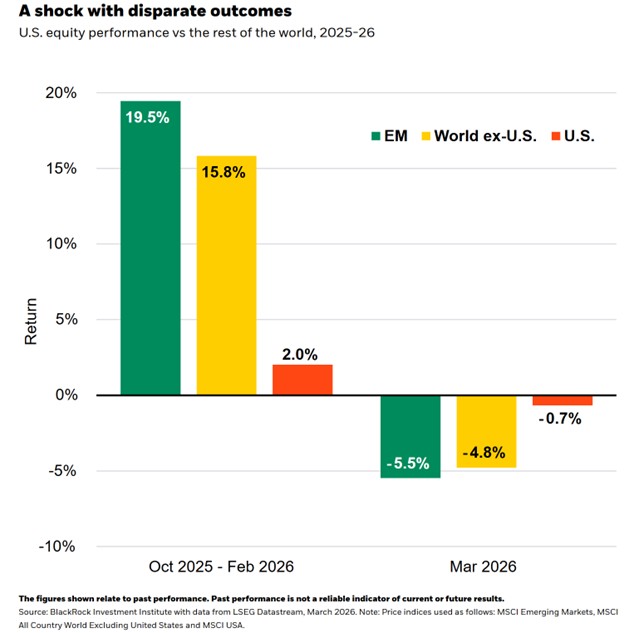
The recent outperformance of emerging markets and the rest of the world relative to the U.S. has abruptly reversed this month. The commentary suggests, quite reasonably, that greater U.S. oil and gas independence has helped America better weather the storm than those countries that depend more on energy imports. Blackrock’s guess is that economic incentives will motivate both Iran and the U.S. to limit market disruptions to weeks rather than months.
Eric Winograd at AllianceBernstein observes that although the rise in oil prices is significant, other historical events have led to far larger oil price spikes:
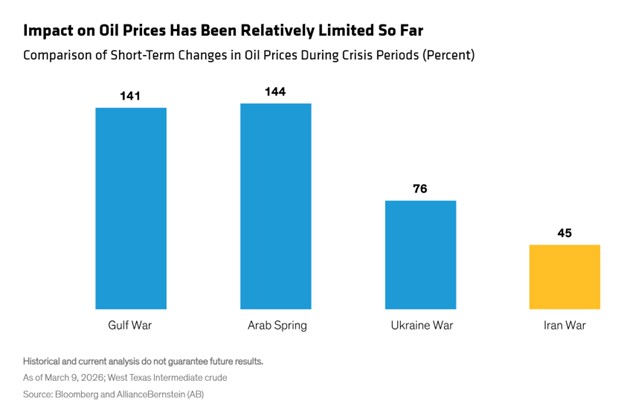
Winograd argues that if prices return to normal quickly, the economic impact of the war will be minimal. But if prices stay higher for longer, we could see inflation become more sticky, as businesses may be more resistant to lowering prices than they were to raising them.
On March 3rd, Goldman Sachs estimated the impact on oil prices of restricted transit through the Strait of Hormuz. The range of price increases was between $1 and $15 per barrel, with a $15 increase characterized by a month-long closure of the strait with no offsets. The article noted that prices can temporarily rise well above fair market value amidst supply concerns and geopolitical uncertainty. As of this writing oil prices are about $30 per barrel higher than their February 27th number of $65 per barrel; if Goldman’s assessment is correct, we should see prices fall if travel through the Strait or Hormuz becomes unrestricted later this month.
KPMG provides a more pessimistic estimate, assessing a 1-month closure of the Strait of Hormuz leading to oil prices exceeding $100 per barrel, and a 3-6 month closure resulting in prices over $130 per barrel. With a longer-term closure KPMG speculates that prices may not fall to pre-war levels until early next year.
A potential fly in the ointment is that Iran may not want to see the Strait of Hormuz opened anytime soon. Patrick Wintour argues that Iran believes that the cost of the war to President Trump needs to be raised to levels high enough that he won’t want to attack Iran again. Whether Iran can impose such costs on the U.S. while enduring its own hardships is unclear. While there are strong economic incentives for the Strait of Hormuz to reopen, it’s unclear how long it will take to navigate the diplomatic obstacles that must be overcome in order to reach that outcome.
JMS Capital Group Wealth Services LLC
417 Thorn Street, Suite 300 | Sewickley, PA | 15143 | 412‐415‐1177 | jmscapitalgroup.com
An SEC‐registered investment advisor.
This material is not intended as an offer or solicitation for the purchase or sale of any financial instrument or investment strategy. This material has been prepared for informational purposes only, and is not intended to be or interpreted as a recommendation. Any forecasts contained herein are for illustrative purposes only and are not to be relied upon as advice.
‹ Back
Recent Posts
-

Interest Rate Movements
September 18, 2026
-

AI Links
September 4, 2026
-
Rising Interest Rates
August 21, 2026
-

Quarterly Market Commentary
August 4, 2026
-

Good News, (Potential) Bad News on the Economy
June 5, 2026