





By using our website, you agree to the use of cookies as described in our Cookie Policy
Blog
Quarterly Market Commentary
2Q 2026 - Key Takeaways
The bull market recovered with a vengeance from its March swoon that followed the onset of the Iran war. Equity indices advanced greatly and broadly in the second quarter of 2026, spanning domestic and foreign stocks, as well as growth and value stocks. Although the S&P 500 remains highly concentrated, the story of 2026 has been a story of catch-up growth from the forgotten 493, as the Magnificent Seven tech stocks were flat for the first half of the year. Strong earnings growth served as a catalyst for higher stock prices that overcame macroeconomic and geopolitical concerns. The Fed has continued to hold rates flat, though markets now expect the Fed to take a slightly hawkish stance rather than a dovish one, with higher rates anticipated by the end of the year. Headline inflation rose with gas prices, while core inflation has remained stubbornly above target. The Iran war has fluctuated between ceasefires, a memorandum of understanding, and renewed hostilities, and shipping traffic through the Strait of Hormuz remains irregular. Whether AI and earnings can continue to make this bull market thrive remains to be seen.
Equity performance in Q2 was strong and broad enough to have Scrooge McDuck swimming in his vault of coins. The S&P 500 rose 15.2% in Q2 2026, while small caps surged 21.6%. Developed international gained 11.1%, while emerging markets climbed 24.1%. On the bond side, the U.S. agg gained 1.1%; as for Treasury rates, the 2- year Treasury rate rose 35bp in Q2, while the 30-year rate increased marginally.
GDP grew at a 2.1% annualized rate in Q1, while the Atlanta Fed’s GDPnow estimate shows Q2 growth at about 1.5%. Both these numbers represent moderate growth. Unemployment ticked down 0.1% over the past three months, to 4.3%, amidst positive but modest employment growth. Headline inflation spiked to 4.2%, largely due to rising energy prices; core inflation also rose significantly, from 2.5% to 2.9%, drifting further away from the Fed’s 2% target. The Fed’s rate cuts in the fall of 2025 are becoming an increasingly distant memory; the Fed has held rates steady throughout 2026.
Second quarter equity performance marked a continued stampeding of the bulls, and it is heartening to see gains broadening across numerous market segments. Strong earnings growth has also helped keep valuations relatively reasonable, suggesting a lessening risk of an AI bubble. While the Iran war has raised inflationary concerns, and the fate of the Strait of Hormuz is still unsettled, these factors have not been significant enough to constitute a major headwind for markets. There’s always a chance of investor reassessment of AI, geopolitical risks, corporate earnings potential, and Fed policy, but for the moment, the bulls have continued to hold court in 2026.
2Q 2026 Investment Letter
Last quarter we wondered whether the first quarter of 2026 was just an Iran-induced pause in the bull market, or an inflection point signaling more challenging times ahead. In Q2, the Iran war become more of a lowergrade, though still ongoing conflict, and markets boomed. GDP growth has been modest but remains positive, unemployment remains under 5%, and core inflation, while almost 1% above target, showed signs of easing in July. The Fed seems unlikely to cut rates anytime soon, given already elevated inflation and the potential for Quarterly Market Commentary 2 2Q 2026 Quarterly Market Commentary | JMS Capital Group Wealth Services LLC further war-induced inflation, but it may be able to continue a wait-and-see approach and refrain from raising rates much, if at all. Some tariff measures have been reconstituted by President Trump, but these may not be large or broad enough to represent a significant drag on markets or the economy. We’ll see whether the 3rd quarter can retain the momentum from the 2nd quarter.
2Q 2026 Market Update
Let’s recapitulate the good news. In Q2 the S&P 500 added 15.2%, while the Russell 2000 mushroomed 21.6%. Developed international and emerging markets posted double digit gains of 11.1% and 24.1%, respectively. In terms of style, small caps, large caps, value, and growth each posted double digit returns in Q2; for the year through June 30th, small value surged 23.0%, small growth rose 22.2%, large value added 16.3%, while large growth climbed 5.3%.
As for sectors, technology led the way with a 31.8% gain for the quarter, followed by industrials at 14.9%. The only two down sectors were utilities, which dropped 0.5%, and energy, which fell 13.4% with the cooldown in the Iran war. Through the first half of the year, industrials, technology, and energy have all posted returns at or near 20%.
Bonds also had a decent quarter, as the US agg added 1.1%, high yield bonds rose 2.4%, and international developed bonds climbed 0.4%. Core inflation increased 0.4%, ending the quarter at 2.9%, which is above the Fed’s 2% target, while GDP growth is projected to be positive, albeit under 2%, in Q2. Treasury rates rose moderately in Q1, particularly for shorter-term rates--the 2-year Treasury rate climbed from 3.79% to 4.14%, the 10-year Treasury rate rose from 4.30% to 4.44%, and the 30-year Treasury rate increased from 4.88% to 4.91%. Volatility was modest, as it was generally in the teens between April and June.
Update on the Macro Outlook
While unemployment has remained under 5%, and GDP growth has been adequate, inflation took a turn for the worse in the second quarter, with core inflation increasing to 2.9%. New Fed Chair Kevin Warsh may have been hoping to renew rate cuts, but elevated inflation makes such a prospect unlikely. Although the Fed’s shift from dovishness to hawkishness may be qualitatively striking, it doesn’t appear that such a shift will be large quantitatively. JPMorgan has a chart detailing both market expectations and Fed projections:
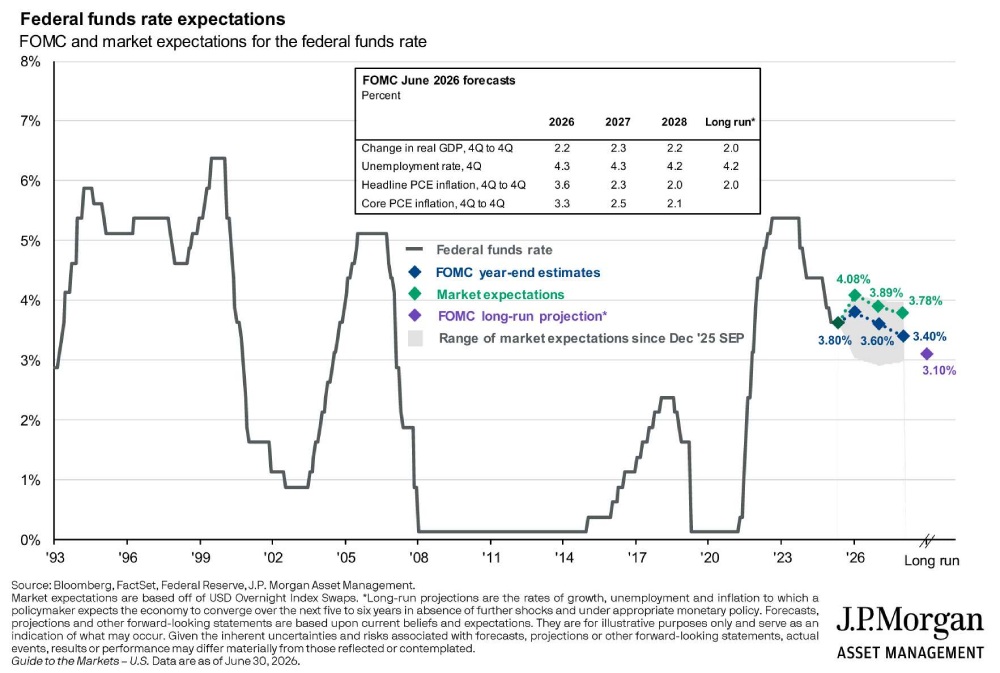
There’s a consensus that the Fed will raise rates 25bp-50bp this year, then cut rates by 25bp-50bp over the next 2 years, with markets expecting slightly higher rates. Three months ago the Fed projected 1 rate cut in 2026, while markets expected rates to stay flat—so that during the second quarter both Fed and market expectations of the federal funds rate shifted up by about 50bp. The Fed thus appears to have shifted from mildly dovish to mildly hawkish. As the chart also shows, Fed macroeconomic projections are for GDP growth of just over 2%, steady unemployment rates just over 4%, and inflation that gradually moves to the Fed’s 2% target by 2028. Given fairly benign economic conditions, the Fed may continue to take a relatively wait and see approach with respect to inflation and any Iran war fallout.
Oil prices rose sharply during the Iran war, but normalized as the war cooled:
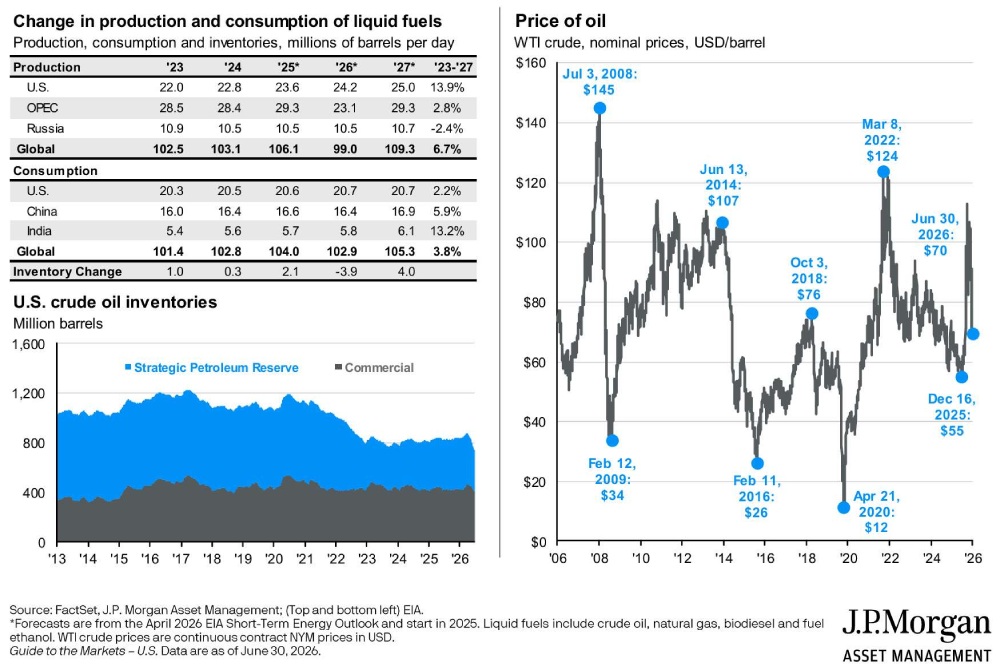
During July oil prices rose again as President Trump renewed military strikes on Iran, but have eased somewhat after the strikes concluded. Whether we are in a temporary cessation of hostilities or a longer-term truce is unclear. There also may be a fundamental divide between the U.S. and Iran with respect to the Strait of Hormuz—Iran seems determined to exercise greater control over the Strait, perhaps with the imposition of tolls or fees, while the U.S. wants shipping to revert back to its free-flowing pre-war state. It’s not clear how such a dispute will be resolved.
Oil prices have stayed within historical norms, though that’s in part due to releases from the Strategic Petroleum Reserve. Should reserves be exhausted, oil prices could surge. The likelihood or extent of such an event is unclear—it’s a layer of geopolitical uncertainty that could yield supply shocks and supply chain snarls. However, given upcoming midterm elections, President Trump may calibrate military action so as not to spook markets; so far, markets have very much taken the war in stride.
Portfolio Positioning and Closing Thoughts
As we mentioned earlier, the S&P 500 was up over 15% year to date as of June 30th despite getting near-zero returns from the Magnificent Seven—Amazon, Apple, Google, Meta, Microsoft, Nvidia, and Tesla:
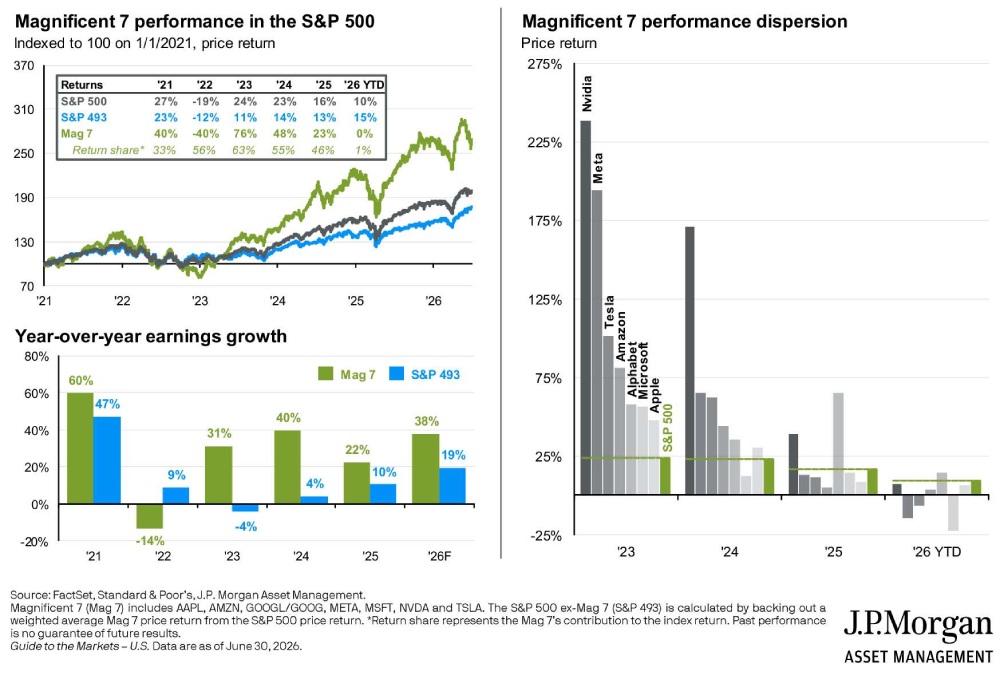
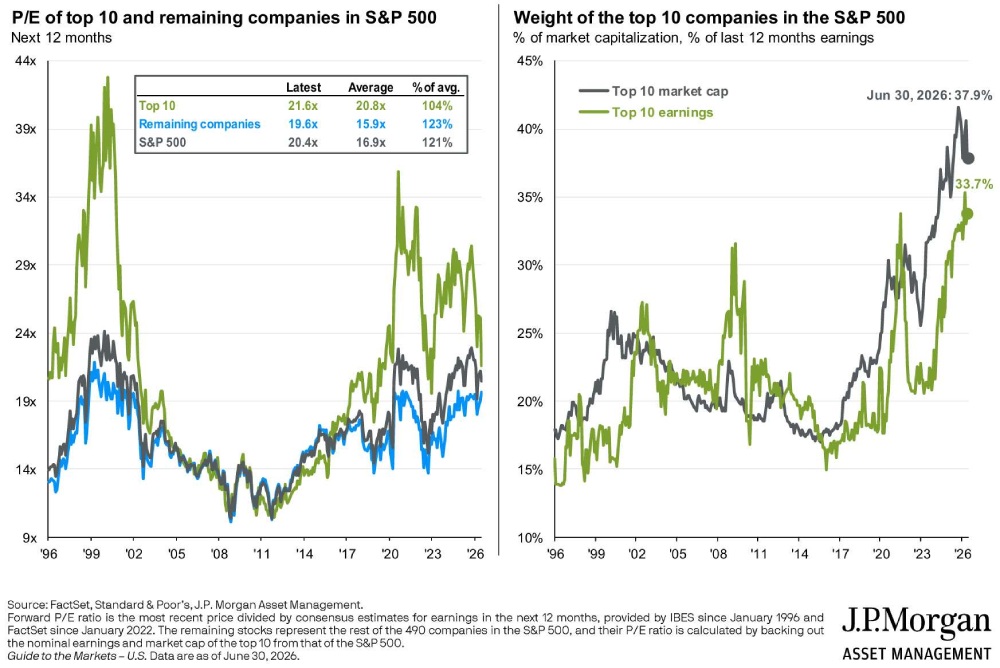
The Mag 7 constituted about half of the S&P 500’s index returns for each of the past three years, so it’s nice to see the bull market has diversified significantly this year. The above chart also shows excellent earnings growth for the Mag 7 from 2023 to 2026. S&P 500 concentration, while elevated, has diminished, while valuations of the mega cap stocks do not suggest an imminent bubble:
Equity markets have staged an impressive recovery from the volatility experienced during the early stages of the Iran conflict, with major indexes rebounding sharply from their lows. Despite continued geopolitical uncertainty, investor sentiment has improved as corporate fundamentals have remained resilient and economic data has generally supported continued expansion.
A key driver of this year’s market strength has been another solid earnings season. While equity valuations have risen alongside stock prices, stronger-than-expected corporate profits have largely justified those gains, preventing valuations from becoming materially more stretched. Companies have continued to demonstrate an ability to grow earnings despite a higher interest rate environment and ongoing macroeconomic ncertainty.
Inflation remains an important risk for investors. Although price pressures have moderated from their peak levels, the geopolitical backdrop continues to present upside risks, particularly if disruptions to global energy markets persist. With the Iran conflict still unresolved, markets remain sensitive to any developments that could reignite inflationary pressures or alter the outlook for monetary policy.
While artificial intelligence continues to serve as an important catalyst for equity markets, leadership has broadened meaningfully throughout 2026. Technology companies tied to the AI theme remain among the strongest performers, but market participation has expanded well beyond the largest growth names. Energy companies have emerged as one of the year’s leading sectors, benefiting from geopolitical uncertainty, resilient commodity prices, and strong cash flow generation. Financials, industrials, healthcare, and other valueoriented sectors also contributed meaningfully to market gains in the second quarter, creating a healthier and more balanced market environment than investors experienced over the past several years.
One of the more notable developments has been the resurgence of small- and mid-cap stocks. After several years of lagging large-cap equities, these segments have delivered strong returns and developed surprising momentum. Even after their recent outperformance, relative valuations remain attractive compared to largecap U.S. stocks, supporting the case for maintaining allocations despite the recent gains.
International equities have also continued to reward investors. Following a very strong 2025, developed international markets have essentially kept pace with U.S. equities during 2026 while continuing to trade at more attractive relative valuations. Emerging market equities have likewise benefited from improving economic conditions and remain attractively valued relative to many developed markets, reinforcing the benefits of maintaining diversified global equity exposure.
Looking ahead, we continue to see opportunities across equity markets, although selectivity remains important. We maintain a modest preference for value-oriented sectors where relative valuations remain compelling and earnings fundamentals continue to improve. We also believe international and emerging market equities have additional room to appreciate, supported by favorable valuations and improving economic trends.
While small- and mid-cap stocks have experienced a significant rally this year, we are not inclined to reduce exposure simply because of recent performance. Valuations remain attractive relative to historical levels and compared with large-cap stocks. That said, we are monitoring several risks that could create periods of volatility, including the possibility that interest rates remain elevated for longer than markets currently expect and the continued emphasis on tariffs and trade policy by the current administration. Even with these considerations, we believe maintaining strategic allocations to these areas remains appropriate for long-term investors.
Fixed income markets have experienced a more challenging environment as interest rates have drifted higher throughout the year. Rising yields have weighed on longer-duration bonds, leaving the Bloomberg U.S. Aggregate Bond Index relatively flat despite its income generation.
In contrast, short-term fixed income has remained an attractive destination for investors. Higher short-term interest rates have allowed investors to earn compelling yields while limiting interest rate risk, making shortduration strategies an effective source of income and capital preservation in the current environment.
Multi-sector bond strategies have also continued to perform well. By allocating across a broader opportunity set—including investment-grade corporates, high yield, securitized assets, and global fixed income—these strategies have generally provided higher yields than traditional core bonds while offering attractive diversification alongside short-term fixed income holdings.
Emerging market debt has delivered another strong year as improving fundamentals, resilient credit conditions, and attractive income opportunities have supported returns. For investors seeking additional yield and diversification, emerging market bonds continue to represent a valuable component of a well-balanced fixed income allocation.
Looking ahead, our fixed income positioning remains largely unchanged. We continue to favor short-term bonds as the foundation of portfolios, providing attractive income, stability, and flexibility in an uncertain interest rate environment. We also believe multi-sector bond strategies remain an attractive complement, offering enhanced yield potential and diversified sources of return beyond traditional core fixed income.
Should longer-term Treasury yields continue to move higher in the coming months, we would view that as an opportunity to gradually increase allocations to core investment-grade bonds. Higher yields would improve prospective long-term returns while allowing investors to lock in more attractive income levels, enhancing the role of core fixed income as both a source of income and portfolio diversification.
—JMS Team
JMS Capital Group Wealth Services LLC
417 Thorn Street, Suite 300 | Sewickley, PA | 15143 | 412‐415‐1177 | jmscapitalgroup.com
An SEC-registered investment advisor
This material is not intended as an offer or solicitation for the purchase or sale of any financial instrument or investment strategy. Certain material in this work is proprietary to and copyrighted by Litman Gregory Analytics and is used by JMS Capital Group Wealth Services LLC with permission. This material has been prepared for informational purposes only, and is not intended to provide, and should not be relied on for, accounting, legal or tax advice. Any references to future returns are not promises - or even estimates - of actual returns a client portfolio may achieve. Any forecasts contained herein are for illustrative purposes only and are not to be relied upon as advice or interpreted as a recommendation for a specific investment. Past performance is not a guarantee of future results.
With the exception of historical matters, the items discussed are forward-looking statements that involve risks and uncertainties that could cause actual results to differ materially from projected results. We have based these projections on our current expectations and assumptions about current and future events - as of the time of this writing. While we consider these expectations and assumptions to be reasonable, they are inherently subject to significant business, economic, competitive, regulatory and other risks, contingencies and uncertainties, most of which are difficult to predict and many of which are beyond our control. There can be no assurances that any returns presented will be achieved.
‹ Back
Recent Posts
-

Interest Rate Movements
September 18, 2026
-

AI Links
September 4, 2026
-
Rising Interest Rates
August 21, 2026
-

Quarterly Market Commentary
August 4, 2026
-

Good News, (Potential) Bad News on the Economy
June 5, 2026